
Blog
Your Front Door Is Watching. But Is It Always On?

“Security is not something you have. It is something you maintain — continuously, without gaps, without the moments you forgot to charge the battery.”
There is a particular kind of unease that settles in when you check your Ring app and find a dead doorbell. Not the dramatic unease of an alarm going off. Something quieter. The realization that for the past several hours — maybe longer — your front door was unguarded. That whatever happened in that window happened invisibly, unrecorded, beyond reach.
How often has that happened to you? How many times has a low-battery notification gone unanswered because life got in the way? How many times have you pulled out the battery, charged it, reinstalled it — and quietly wondered whether there was a smarter way?
There is. And it costs less than most people think.
The Ring Solar Charger 2nd Generation was built to answer a single question that every Ring doorbell owner eventually asks: what if it never ran out?🔴 Check Ring Solar Charger 2nd Gen Price on Amazon.ae
The Problem Nobody Talks About With Battery Doorbells
When was the last time your Ring doorbell went dark — and you didn’t notice until it was too late?
Battery-powered doorbells are one of the most genuinely useful smart home inventions of the past decade. No wiring. No electrician. Mount it, connect it, and suddenly your front door has eyes. The promise is real and it holds up — until the battery dies.
And it always dies. At the most inconvenient moment, in the middle of the week when you’re traveling, during the night when nobody thinks to check. Ring’s battery life is impressive for what it does — recording video, detecting motion, sending alerts, maintaining a wireless connection — but a doorbell that does all of that continuously is always fighting a losing battle against battery drain.
The average Ring Battery Doorbell needs charging every one to six months depending on motion frequency, settings, and climate. In a busy household with significant foot traffic or frequent deliveries, that window shrinks. And every time it shrinks past zero — every time the battery dies before you recharge it — there is a gap. A period of time your home was unmonitored. A window your security system didn’t cover.
⚠ A doorbell with a dead battery is not a security device. It is a piece of plastic on your wall. The Ring Solar Charger 2nd Generation exists to make sure that never describes your home.
“The goal of home security isn’t to respond to what happened. It’s to ensure that nothing goes unrecorded in the first place.”
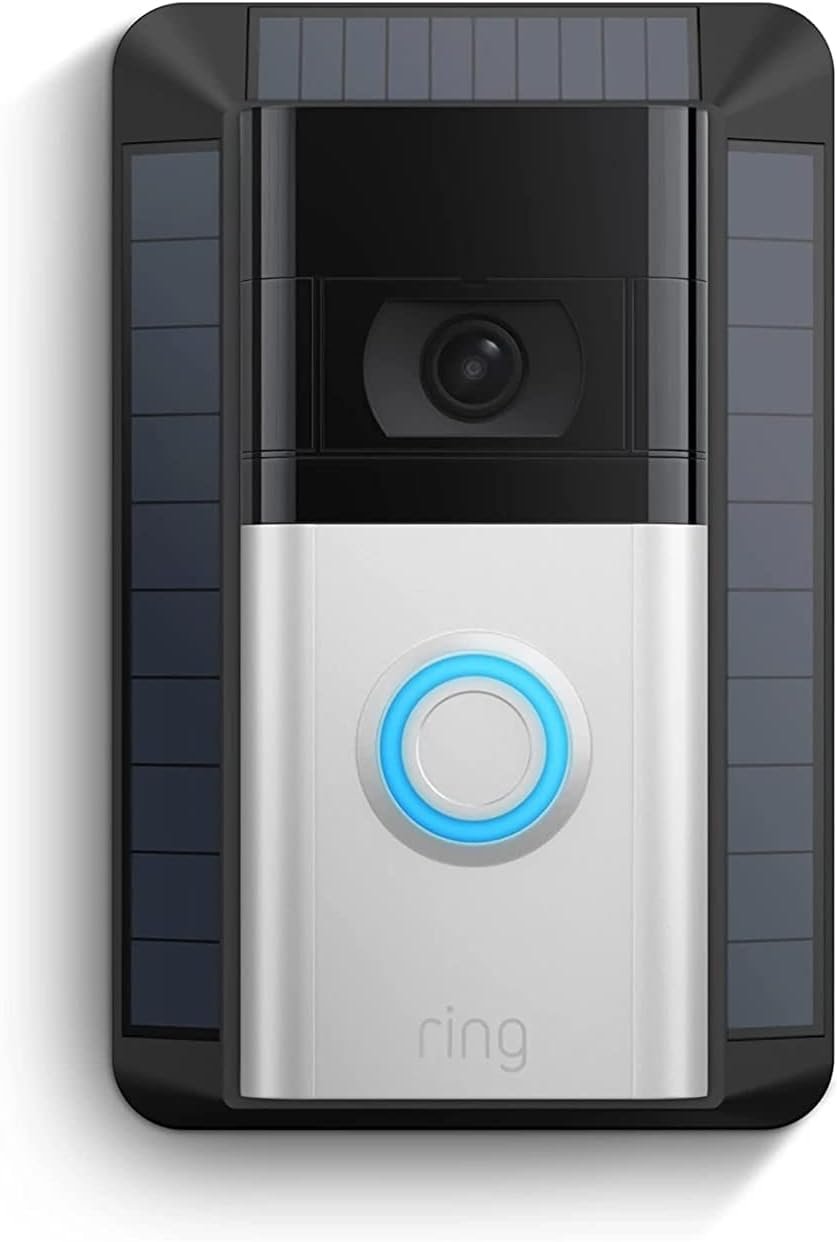
Ring Solar Charger (2nd Generation) for Battery Doorbells, Ring Video Doorbell 3, Ring Video Doorbell 3 Plus, Ring Video Doorbell 4
- Extend the battery life of your Ring Video Doorbell 3, Ring Video Doorbell 3 Plus or Ring Video Doorbell 4 with the help of a solar power source.
- Keeps your Ring Video Doorbell charged up to 35% longer than previous solar charger generations.
- Includes a secure mounting...
What the Ring Solar Charger 2nd Generation Actually Does
The Ring Solar Charger 2nd Generation is a small, weather-resistant solar panel that mounts directly behind your compatible Ring battery doorbell. It connects via a fork-style power connector and trickle-charges the doorbell’s battery continuously during daylight hours — extending battery life by up to 35% more than the previous generation solar charger.
It doesn’t replace your doorbell’s battery. It maintains it. Think of it as a constant, silent top-up — a slow, steady drip of solar energy that offsets the power your doorbell uses for motion detection, video recording, and connectivity throughout the day. With three to four hours of direct sunlight daily, most users find their doorbell battery stays perpetually in the high range, rarely if ever needing manual removal and charging.
| Specification | Detail |
|---|---|
| Generation | 2nd Generation — 35% more effective than 1st Gen solar charger |
| Solar Panel | Built-in weather-resistant solar panel — designed for permanent outdoor exposure |
| Connector Type | Fork-style power connector — compatible with specific Ring Battery Doorbells only |
| Sunlight Required | Minimum 3–4 hours of direct sunlight per day for optimal charging |
| Battery Impact | Extends battery life — keeps charge topped up continuously during daylight |
| Mounting | Secure mounting bracket included — no additional holes required in most cases |
| Weather Resistance | Yes — designed for all weather conditions including rain and heat |
| App Integration | No app setup required — plug in and it begins working immediately |
| Installation | Mounts behind the doorbell using existing wall holes — screws and screwdriver included |
| Orientation | Face south (Northern Hemisphere) or north (Southern Hemisphere) for best results |
| Compatibility | Fork-style connector Ring doorbells only — see compatibility table below |
| Warranty | 1-year limited warranty from Ring |
| Color | Black |
35%More effective than 1st Gen — measurable battery life extension
3–4 hrsDirect sunlight needed daily for continuous charging
0App setup required — plug in, it starts working
Is Your Doorbell Compatible? — The Full Table
Before anything else — does the 2nd Gen Solar Charger actually work with your specific Ring doorbell?
This is the most important question to answer before purchasing, and it’s one Ring’s product naming makes unnecessarily confusing. The 2nd Generation Solar Charger uses a fork-style connector — not micro-USB, not USB-C. Only specific Ring doorbell models use this connector. Here is the complete compatibility breakdown:
| Ring Doorbell Model | Compatible? | Notes |
|---|---|---|
| Ring Video Doorbell 3 | ✔ YES | Primary compatible model — fork connector |
| Ring Video Doorbell 3 Plus | ✔ YES | Primary compatible model — fork connector |
| Ring Video Doorbell 4 | ✔ YES | Primary compatible model — fork connector |
| Ring Battery Doorbell Plus | ✔ YES | Compatible — confirm connector type on your unit |
| Ring Battery Doorbell Pro | ✔ YES | Compatible — confirm connector type on your unit |
| Ring Video Doorbell (1st Gen) | ✘ NO | Uses micro-USB — different solar charger required |
| Ring Video Doorbell (2nd Gen) | ✘ NO | Has its own dedicated solar charger — not this one |
| Ring Video Doorbell 2 | ✘ NO | Uses micro-USB — different solar charger required |
| Ring Wired Doorbells | ✘ NO | Already hardwired — no battery solar charger needed |
| Ring Spotlight / Stick Up Cams | ✘ NO | Require Ring Solar Panel for cameras — different product |
⚠ Compatibility check: If your Ring doorbell uses a micro-USB or USB-C charging port, this is NOT the right solar charger. The 2nd Gen Solar Charger uses a fork-style connector exclusively. Check your doorbell’s charging port before purchasing.
What Changes When Your Doorbell Never Dies?
Have you considered what it would mean — not just practically but philosophically — to have a home that is genuinely, continuously watching over itself?
There’s a version of smart home security that most people never quite reach. Not because the technology doesn’t exist, but because it requires every component to be working at the same time, consistently, without the human maintenance loops that inevitably introduce gaps. A doorbell that needs charging every few months is a security system with built-in blind spots. The solar charger is the piece that closes that loop.
What happens to your peace of mind when you stop thinking about the battery?Security becomes something you have, not something you manage.
The mental overhead of maintaining a battery-powered security device is real — low battery alerts, removal, charging, reinstallation, the anxiety of the gap in between. Eliminate that cycle and something shifts. Your home’s security stops being a task on your list.
What does a front door recording without interruption actually protect you from?The things that happen precisely when nobody is looking.
Package theft, opportunistic crime, and doorstep incidents don’t announce themselves during convenient charging windows. Continuous recording means no unexplained gaps in footage — no “the battery happened to die that morning” conversation with police or insurance.
What does it cost you to remove, charge, and reinstall a doorbell battery every few months?More than the solar charger costs — measured in time, friction, and gaps.
One battery removal and charge cycle takes 20–30 minutes including the offline window. Over two years, that’s potentially 4–8 cycles — hours of your time, and hours of an unmonitored front door. The solar charger pays for itself in both.
If the sun can maintain your security system for free — why wouldn’t it?There is no good answer to that question.
The solar charger requires no electricity from your home, no subscription, no ongoing cost. Sunlight hits the panel, the panel tops up the battery, the doorbell stays on. It is the most passive possible solution to an active, recurring problem.
How to Install It — Simpler Than You Think
What if the thing standing between you and a permanently maintained doorbell was a fifteen-minute installation?
The Ring Solar Charger 2nd Generation is designed to use your doorbell’s existing wall mounting holes. In most installations no new drilling is required. Here is the complete process:
STEP 1
Fully charge your doorbell battery first. Before installing the solar charger, remove the doorbell’s battery and charge it to 100% via USB. The solar charger maintains charge — it doesn’t perform a full charge from zero quickly enough to be relied upon as a primary charger from a depleted state.
STEP 2
Choose your mounting location carefully. The solar charger needs 3–4 hours of direct, unobstructed sunlight per day. Avoid covered porches, north-facing walls in the Northern Hemisphere, and positions shaded by overhangs, trees, or neighbouring structures. South-facing walls in the Northern Hemisphere (or north-facing in the Southern Hemisphere) are optimal.
STEP 3
Remove your existing doorbell from the wall. Unscrew the doorbell from its mounting bracket using the included screwdriver. The solar charger mounts behind the doorbell using the same holes — no new fixings required in most standard installations.
STEP 4
Attach the solar charger bracket to the wall. Position the solar charger’s mounting bracket against the wall, align with the existing holes, and secure with the provided screws. The bracket holds both the solar panel and your doorbell in the correct orientation.
STEP 5
Connect the fork-style connector to your doorbell. The solar charger’s cable connects directly to the charging port on the back of your compatible Ring doorbell. The connection is designed to be secure and weatherproof — push firmly until it seats fully.
STEP 6
Mount the doorbell and you’re done. Reattach the doorbell to the bracket, tighten the security screws on the base, and the installation is complete. No app configuration required — the solar charger begins working immediately when it receives direct sunlight. The Ring app’s Device Health page will continue showing “Battery” as the power source — this is normal and expected behaviour.
⚠ Critical placement note: The solar charger will NOT work on covered porches, in shaded positions, or in regions that receive fewer than 3 hours of direct sunlight daily on average. If your doorbell is currently mounted in a shaded position, the solar charger will provide minimal benefit. Assess your sunlight exposure honestly before purchasing.
Honest Pros & Cons
| ✔ WHY HOMEOWNERS CHOOSE IT | ✘ WHAT TO KNOW FIRST |
|---|---|
| Eliminates manual battery charging cycle | Requires 3–4 hrs direct sunlight daily — not ideal for shaded doors |
| 35% more effective than 1st Generation charger | Compatible with fork-connector models only — check before buying |
| Zero app setup — works immediately on connection | Does not show as “solar” in Ring app — still shows “battery” |
| No ongoing cost — sunlight is free | Won’t fully charge a depleted battery quickly — top up manually first |
| Weather resistant — works in rain, heat, cold | Not compatible with covered porches or north-facing walls (N. Hemisphere) |
| Uses existing wall holes — minimal installation effort | Battery life still varies with motion frequency and settings |
| Secure mounting bracket included in box | 1-year warranty only — shorter than some smart home accessories |
| Passive security maintenance — works while you sleep | High-traffic doorbells may still need occasional manual charging |
What Real Homeowners Are Saying
“I was charging my Ring doorbell every 6–8 weeks. Since installing the solar charger six months ago, I haven’t touched the battery once. It sits at 90–100% consistently. This is genuinely the upgrade my Ring system needed.”
— Verified Amazon Buyer · ⭐⭐⭐⭐⭐
“Installation took about 20 minutes and that included the time I spent reading the instructions twice to be sure. South-facing door, good direct sun — the charger keeps the battery perpetually full. Exactly what it promises.”
— Verified Amazon Buyer · ⭐⭐⭐⭐⭐
“One honest note: in winter months with shorter days, the battery drops more than in summer. It still extends life considerably but doesn’t fully eliminate charging if you’re in a northern latitude with low winter sun. Manage that expectation and you’ll be happy.”
— Verified Amazon Buyer · ⭐⭐⭐⭐
“I have high motion activity — a busy street, constant deliveries. The solar charger hasn’t eliminated charging entirely but it’s extended my intervals from every 3 weeks to every 3 months. For that alone it was absolutely worth it.”
— Verified Amazon Buyer · ⭐⭐⭐⭐
Frequently Asked Questions
Q: Will it keep the doorbell charged indefinitely — or just extend the battery?
For most users in locations with consistent direct sunlight, the solar charger effectively maintains the battery indefinitely during fair-weather months — meaning manual charging becomes very rare or unnecessary. In winter months, at higher latitudes, or in high-motion environments, it extends battery life significantly but may not eliminate manual charging entirely. The honest answer is: for most homeowners in most situations, you will stop thinking about the battery.
Q: Does it work on cloudy days?
Partially. The solar panel generates some energy from diffuse daylight on overcast days, but significantly less than from direct sunlight. Extended cloudy periods will reduce the charger’s effectiveness. In predominantly cloudy climates — consistent rainfall, northern winters with minimal daylight — the solar charger will still extend battery life but may not maintain it perpetually. In the UAE and similar sun-rich environments, effective year-round performance is reliably achieved.
Q: Will I see anything change in the Ring app after installing it?
No — the Device Health page in the Ring app will continue to show “Battery” as the power source even after the solar charger is connected. This is expected and documented behaviour. The solar charger is a passive power source — Ring’s app architecture doesn’t distinguish between a maintained battery and an unassisted one. You’ll observe the benefit in how rarely the battery percentage drops, not in any specific app indicator.
Q: Does the solar charger work with Ring’s Wedge or Corner mounting kits?
Yes — Ring confirms the Solar Charger 2nd Generation is compatible with both the Wedge Kit and the Corner Kit for compatible doorbell models. Ring recommends using only one angled kit at a time with the solar charger to avoid compromising the sun-facing orientation of the panel.
Q: What if my door doesn’t face south?
East and west-facing walls can still receive sufficient direct sunlight depending on your specific location and surrounding obstructions. South-facing is the recommended orientation for maximum daily sun exposure in the Northern Hemisphere. Before purchasing, observe your doorbell’s current location across a full day — if it receives at least 3–4 hours of direct, unobstructed sunlight, the solar charger will function effectively regardless of compass direction.
Q: Is the 2nd Generation meaningfully better than the 1st Generation?
Yes — Ring states the 2nd Generation is up to 35% more effective at extending battery life than the previous model. The panel efficiency and mounting design have both been improved. If you currently have a 1st Generation solar charger and find it insufficient for your usage patterns, upgrading to the 2nd Generation is a meaningful improvement rather than a cosmetic one.
The Question You Should Ask Yourself
Your front door is the first line of everything your home security system is supposed to protect. It is where strangers approach, where deliveries arrive unwitnessed, where the quiet moments that matter most go unrecorded when a battery decides to die at the wrong time.
The Ring Solar Charger 2nd Generation is not a complex product. It is not a revolutionary one. It is a simple, passive solution to the most common failure mode of an otherwise excellent security system — the human dependency of remembering to charge it.
The homeowner who installs this stops managing their security system and starts trusting it. That shift — from active maintenance to passive confidence — is what this product actually sells. And for anyone with a compatible Ring doorbell and a south-facing sun-exposed door, it delivers exactly that.
The only real question is: how many more times do you want to see that low-battery notification before you do something about it?
🛡️
Our Rating: 4.5 / 5 Stars
Highly Recommended — The Smartest Single Upgrade for Compatible Ring Battery Doorbell Owners
🔴 Get the Ring Solar Charger 2nd Gen — Check Price on Amazon.ae
Compatible with Ring Video Doorbell 3, 3 Plus, 4, Battery Doorbell Plus & Pro
Affiliate Disclosure: This article contains affiliate links. If you purchase through our links we may earn a small commission at no extra cost to you. All specs and compatibility information sourced from Ring.com official product pages and Amazon.ae listing (ASIN: B0B3FCLY26). Published March 10, 2026.